
Read Lake County Deed Records by Instrument Type
A deed record shows one thing clearly: a specific instrument was received and recorded. Its legal weight depends on the document itself, the parties, proper execution, and the surrounding chain. In Lake County, the deed index sits alongside mortgages, assignments, releases, land contracts, liens, easements, restrictions, probate instruments, and court orders.
| Deed Type | What It Does | Common Use |
|---|---|---|
| Warranty deed | Conveys the grantor's interest with stated covenants | Ordinary arms-length conveyance |
| Quitclaim deed | Conveys whatever interest the grantor has without the same warranties | Family, estate, or interest cleanup |
| Personal-representative or trustee deed | Conveys through an authorized fiduciary | Estate or trust administration |
| Land contract or assignment | Records a contractual or assigned interest | Installment transaction or transferred contract rights |
| Tax or court-related deed | Reflects an authorized transfer after the applicable process | Tax foreclosure or judicial proceeding |
A mortgage or lien burdens an interest rather than conveying it the way a deed does. Always chase the follow-up instruments. Releases, discharges, and assignments control the outcome, and an old lien entry by itself says nothing about its present status.
The Clerk/Register of Deeds Is the County Custodian
The Lake County Clerk/Register of Deeds keeps the deed records at 800 Tenth St, Suite 200, Baldwin, MI 49304, telephone 231-745-2725. Office hours run Monday through Thursday 8:30 a.m.–5 p.m. and Friday 8:30 a.m.–4 p.m. The official page displays links to LandWeb, recording rules, fees, and the activity-alert service. It also marks the county's current starting point for deed research. Staff handle requests when the index falls short.
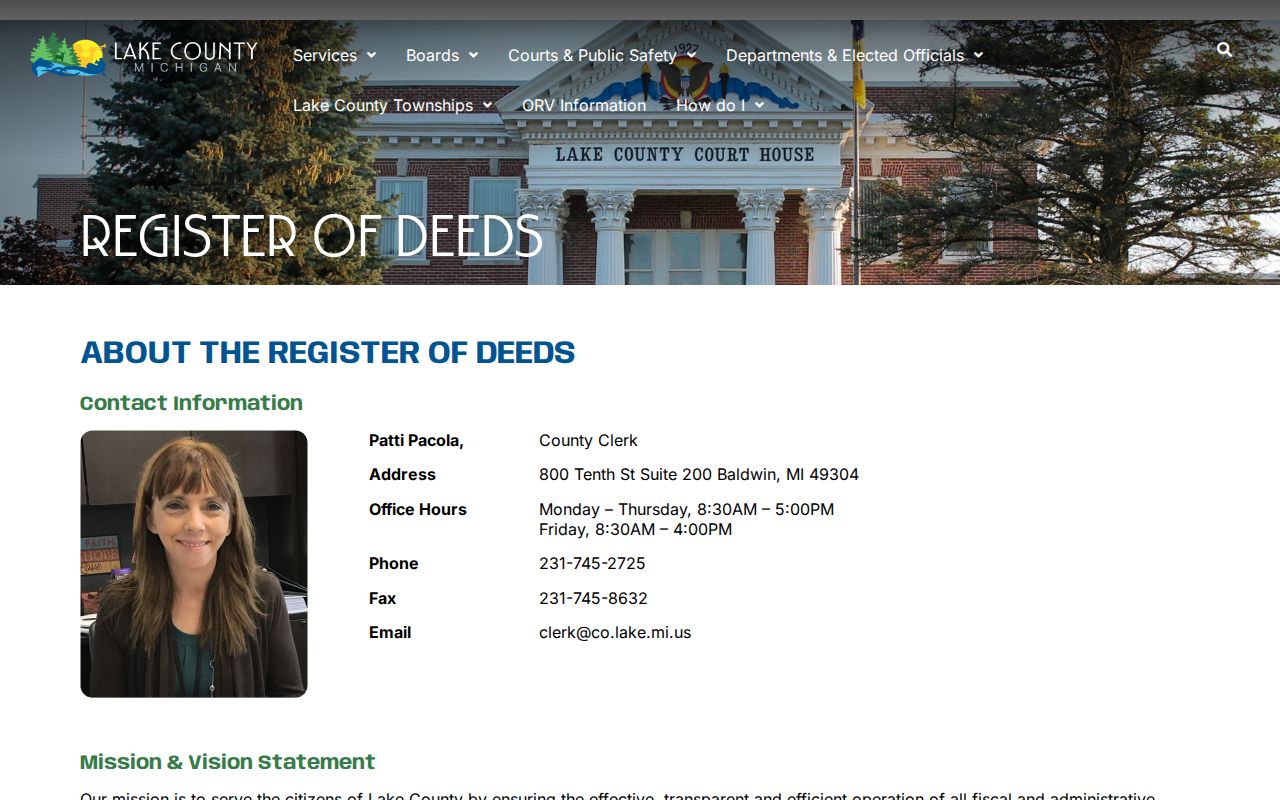
Go to the office directly when the online index is unavailable. The same applies when you need a certified copy, or when a pre-index deed must be pulled from the vault by hand.
Walk Lake County's Grantor-Grantee Index Carefully
The LakeWeb-LandWeb endpoint is the county's official index route. Its live search fields may look different from what you expect. The dependable method works backward. Start from a known current grantee and move step by step. Check the legal description at every link in the chain.
- Confirm the current parcel ID and legal description through the Lake County property search.
- Search the displayed owner as grantee and open the most recent plausible acquisition instrument.
- Verify the land description, then copy the grantor, recording date, deed type, and instrument or book/page reference.
- Search that grantor as an earlier grantee and repeat; test initials, prior surnames, trust forms, and punctuation variants.
- When the computer coverage ends, carry the last verified party and description into the vault deed books and reverse index.
- Grantor
- The party conveying an interest.
- Grantee
- The party receiving the interest.
- Chain of title
- The ordered sequence of instruments affecting the same land.
- Book/page or instrument number
- The recorder's retrieval reference; preserve whichever the entry supplies.
April 1988 Separates the Public Computer From the Vault
The official ROD fee schedule draws a line at April 1988. Public-computer and ROD searches cover April 1988 to current. Anything earlier is searched in the vault. That statement covers office searches only. It does not confirm the web LandWeb index starts on the same date. Treat April 1988 as the office-search boundary. Ask staff about web coverage.
Older deed books, reverse indexes, plats, and tax materials carry the trail beyond the portal. The Archives of Michigan county guide lists a Rural Property Inventory for 1936–1942. It also lists township tax-roll series. The Lake County Historical Museum research library adds maps and local newspapers. Those help resolve names and descriptions. These sources give context. Meanwhile, the recorded deed book remains the conveyance evidence.
Coverage limit. Do not advertise all deeds since April 1988 as online; only public-computer/ROD access for that span is confirmed.
The Legal Description Keeps the Chain on One Parcel
Names alone are unsafe in a grantor-grantee search. Compare the full lot and block with the plat name on every transfer. The section-township-range description works too. Lake County began permanent parcel numbering in 1987. An older deed may lack today's PIN. A split or combination can also replace an administrative identifier. The underlying descriptions keep the history.
The county plat list includes clusters like Baldwin Avenue subdivisions, Baldwin Park, and Luther additions. It also lists many Idlewild plats. Use the complete recorded name. Test punctuation variants too. A modern GIS match is a bridge. It is not permission to shorten a description or merge similarly named plats.
Lake County Recording Rules Shape the Document
The register of deeds recording guidelines spell out what an instrument needs. It must meet those terms before it can be recorded in Lake County. Original signatures are required. Printed names must appear beneath them. The document also needs acknowledgment, grantee and preparer addresses, and compliant margins. Valuation or transfer-tax statements apply in some transactions. The guidelines also warn filers not to display Social Security numbers on documents. A rejected or corrected instrument can delay recording. Rely on the recording stamp rather than a signature date alone when ordering the chain of title.
Michigan's recording statute, MCL 565.29, governs notice and later good-faith purchasers. That makes the recorded sequence worth examining closely. It does not replace legal advice about competing interests.
Recorded Liens Need Their Later Releases
Deed records share their index with mortgages and assignments. Discharges, construction liens, tax liens, easements, and restrictions sit there too. Notices such as lis pendens are filed the same way. Match each release to the original instrument it references. Confirm the parcel description agrees as well. A court docket may explain a quiet-title, foreclosure, or probate instrument. But the final recorded document belongs in the ROD file.
The MiCOURT Case Search is informational and excludes nonpublic case types. Lake County Trial Court at 800 Tenth St, Suite 100 holds the local court path. A docket entry is still not a recorded release or deed.
A Name Alert Adds Notice After the Search
Lake County offers a free recording activity alert. It takes a name, an email, and a phone number, then reports later recorded activity under that enrolled name. Enroll aliases separately, since common names can trigger unrelated notices while name variations slip through. The service is a name-based notification, not parcel monitoring.
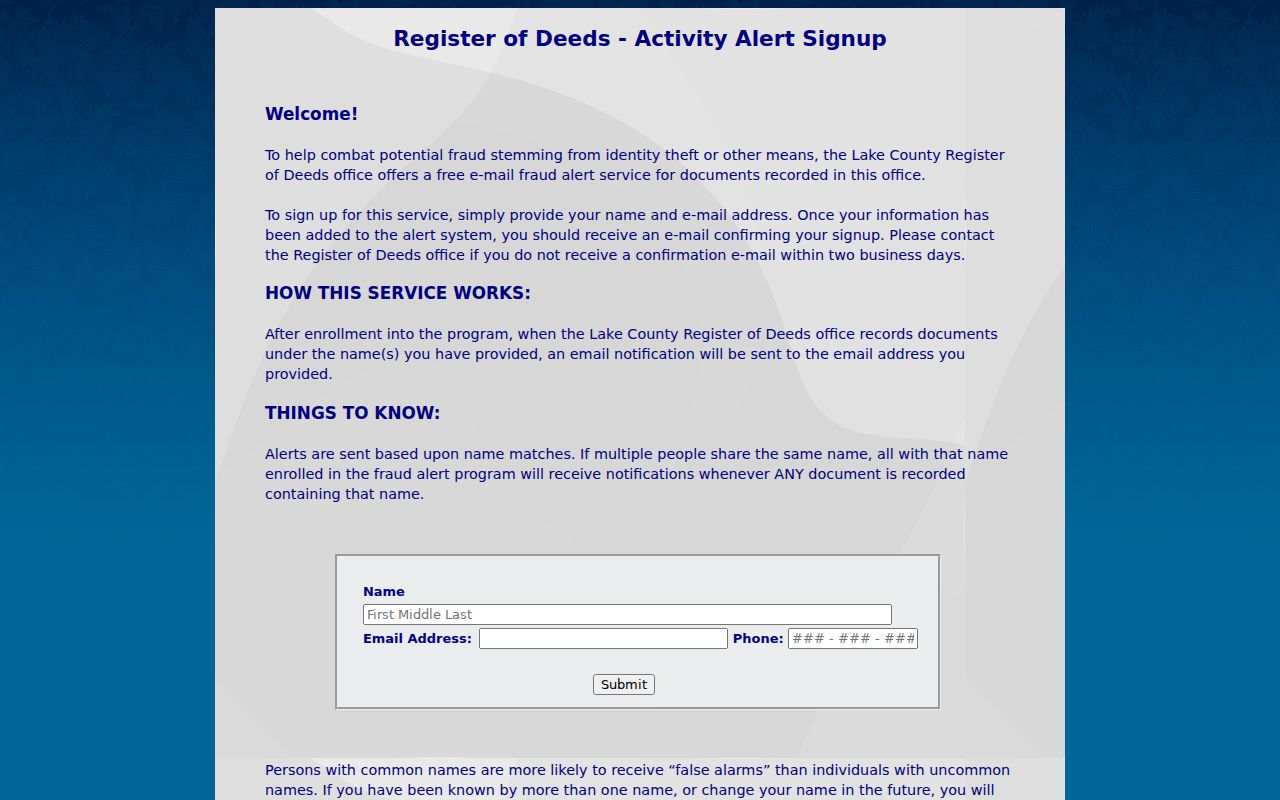
Check any notice against the actual instrument and legal description. The service cannot block a filing, guarantee title, or decide that fraud occurred.
Order a Lake County Deed by Exact Reference
The Register of Deeds can pull any recorded deed. You just need to cite an instrument number or a book and page reference. You may also review an online image yourself when one is available. A request should include both party names and the recording date. Add a parcel number or legal description too. Include a return address and whether you need certification. The published fee schedule sets copies at $1 per page. Certification adds $5 on top of the copy charge. A tract search runs $25 per hour with a one-hour minimum. A vault search carries a two-hour minimum at the same hourly rate. Confirm the current fees before you send payment.
For in-person research, the office offers a public computer covering April 1988 forward. Staff assist with the earlier books. Telephone and mail requests work when LandWeb is down. A FOIA request does not substitute for the Register of Deeds copy service. Follow the ordinary records procedure first.
Recorded, not guaranteed. Lake County deed records show accepted instruments, not a title opinion. Unrecorded interests, indexing errors, competing descriptions, and later instruments may affect the conclusion.