
Lake County Deed Chain Backward
Begin with a verified parcel, never a surname pulled from memory. Start in the Lake County GIS map. Pull the current owner of record, parcel ID, municipality, and legal description there. Then find the newest conveyance in the deed records. Its grantor becomes the prior owner. Every row in the chain must be documented from the recorded instrument itself.
| Transfer Date | Grantor to Grantee | Deed Type | Book/Page or Instrument |
|---|---|---|---|
| Newest | Seller to current grantee | Recorded conveyance | Copy from latest deed |
| Prior | Earlier owner to later seller | Deed or court instrument | Copy the prior reference |
| Parcel origin | Parent tract to new parcel | Plat, split, or deed | Lot/block or full description |
| Older chain | Former owners in vault books | Historic deed | Book and page |
At each step, write down the date and deed type. Record the names, liber and page reference, and stated consideration when given. Copy the full legal description too. Names alone can mislead. A matching name attached to different land belongs to another parcel entirely. A spelling shift, though, does not break the chain. The recorded reference and the land can stay consistent even so.
Lake County's April 1988 Line
The Register of Deeds links to the LakeWeb/LandWeb search service, though the live LakeWeb/LandLand endpoint can be unreachable at times. Its web fields and earliest online year are not published. The official fee schedule tells a clearer story. Free public-computer and Register of Deeds search coverage runs from April 1988 to current. Earlier deed records sit in the vault. That is a courthouse-access cutoff, not a promise the web index is complete from the same month. Use the web service when it loads. Call the office when it fails. A vault search costs $0.50 per year with a $5 minimum. Grantor and grantee index access is listed at no charge, tract-index searching runs $25 per hour, and copies cost $1 per page.
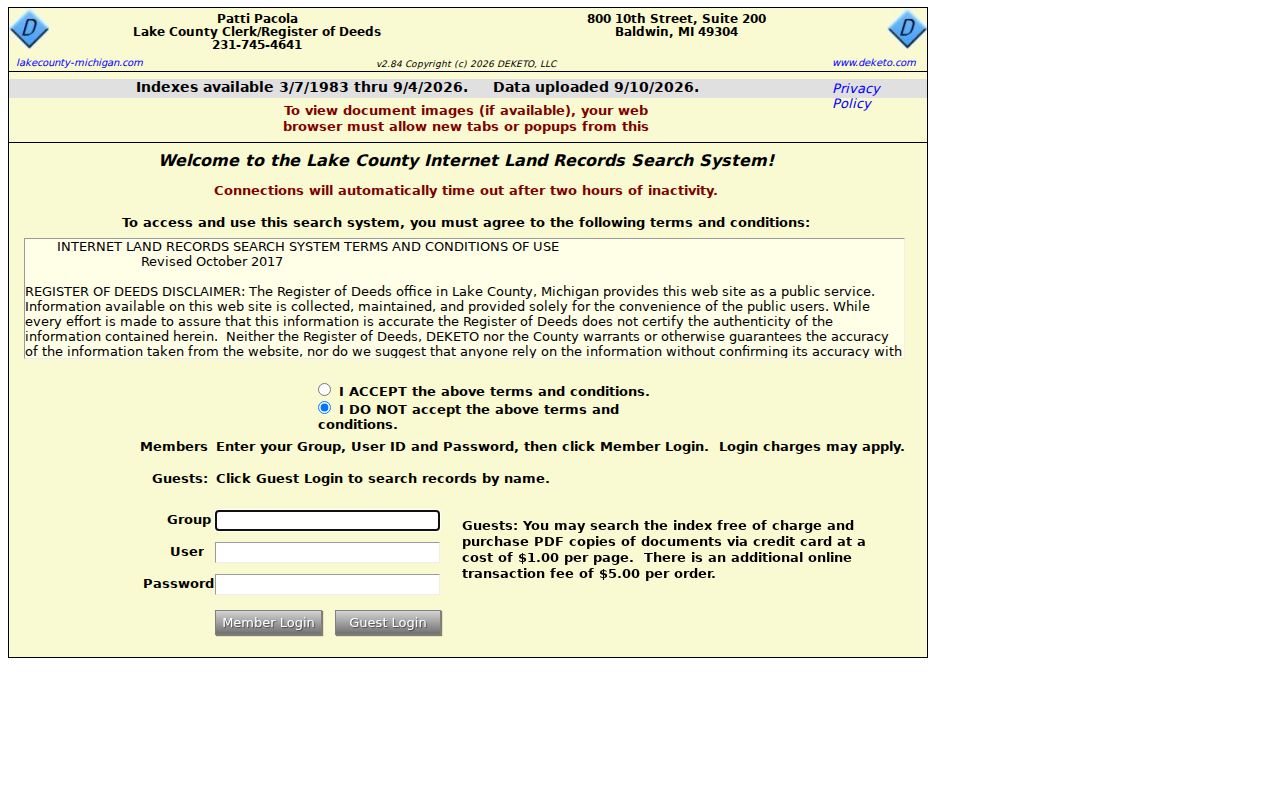
Note: When the web endpoint is down, the courthouse computer, the telephone, and the vault keep the former-owner search moving.
Time-depth limit. April 1988 marks listed public-computer access, not a confirmed LandWeb start date; older owners require vault records.
Cross Lake County's 1987 PIN
Lake County began permanent parcel numbering in 1987 and built its GIS map in 1996. A deed from before that change may carry no PIN at all. Newer numbers can also shift after a split or a combination. The GIS includes retired and new split-and-combine reference classes. So carry the legal description across the break. For platted land, preserve the subdivision, addition, lot, and block. For rural land, hold onto section, township, range, acreage, bearings, and parent-parcel clues. The county survey frame spans townships 17N through 20N and ranges 11W through 14W. Compare all of it before accepting any supposed previous owner.
Note: A modern Lake County PIN is a strong join key, but it is not a permanent historical title identifier.
Plats Reconnect Lake County Owners
A subdivision chain can often be solved with the county plat list. Idlewild holds a dense cluster of names. Those names include Heights, numbered Idlewild plats, Terrace, Twin-Lakes, and Pines. Baldwin and Luther each carry their own village additions. The list shows no dates or images. Its job is narrower: pin down the exact plat name. Then retrieve the recorded plat and match its lots to the deed. That path beats searching former owners by name alone. You move from parcel to plat name, to lot and block. From there you reach the recorded plat or covenant. Finally you arrive at the earlier deed book.
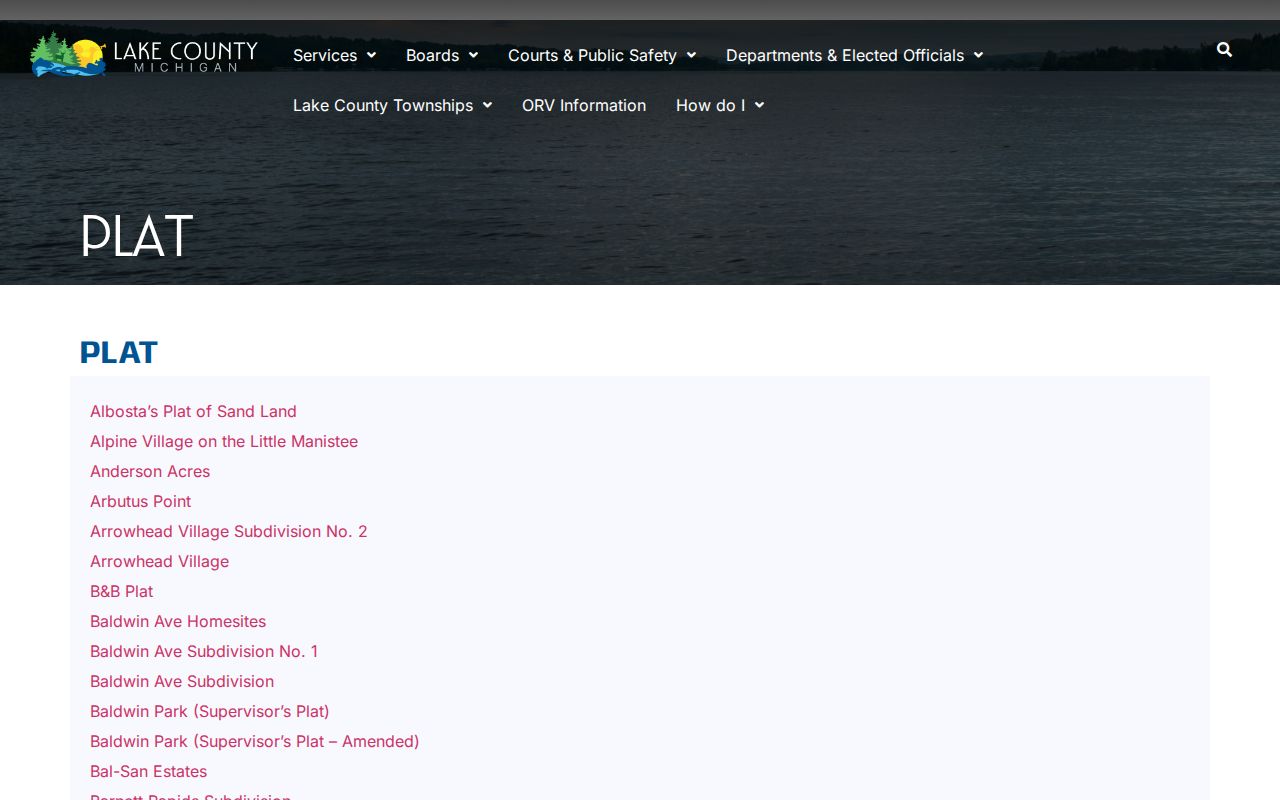
Note: The official plat list is only a lead; the recorded plat and its linked deed establish which land actually changed hands.
Reconstruct Lake County Prior Owners
The reverse search repeats one move. The grantee on the current deed becomes the name to hunt as grantor on the deed by which that party acquired the land. The grantor on that earlier instrument names the owner before that. When the first query misses, search initials, trusts, business names, aliases, and former names before giving up on the parcel.
- Record GIS
OWNERNAME,PARCELID,LEGALDESC, address, and municipality. - Find the current owner as grantee and open the newest matching deed.
- Copy its date, parties, type, reference, and complete legal description.
- Search that grantor as a grantee in the earlier period, then repeat.
- Bridge a split, plat, estate, or cutoff with parent land, court files, or vault books.
- Grantor
- The party transferring the interest stated in an instrument.
- Grantee
- The party receiving that stated interest.
- Chain of title
- The linked series of instruments affecting the same land.
- Reverse index
- An index used to find a party in the opposite deed role.
- Quitclaim
- A transfer of whatever interest the grantor had, without warranty-deed covenants.
Simple chains break at estate, survivor, divorce, foreclosure, and court-order instruments. When a fiduciary, personal representative, sheriff, treasurer, or court signs, check the probate or civil files. Then return to the land description and carry on.
Historic Lake County Owner Sources
The Archives of Michigan lists Elk tax assessment rolls from 1889 through 1939, Sauble tax rolls from 1903 through 1910, and a Rural Property Inventory covering 1936 through 1942. These can place an owner name and parcel description in eras beyond the direct portal trail. Treat them as supporting evidence. They are no substitute for a deed.
Local newspapers add sale, estate, foreclosure, and obituary clues. Lake County Star microfilm runs from 1911 through 2011, with a reported 1993 gap. Luther Observer microfilm covers 1929 through 1932. The Historical Museum research library reports old newspapers, maps, township records, obituaries, and an 1871 law book. Ask for collection titles and current access terms before making the trip.
Visit Lake County's Deed Desk
The Clerk/Register of Deeds works out of 800 Tenth Street, Suite 200, in Baldwin. Doors open Monday through Thursday from 8:30 a.m. to 5 p.m. Friday hours run 8:30 a.m. to 4 p.m. Reach the office at 231-745-2725, or try the deed line at 231-745-4641. Staff can tell you where the year you need sits. It may be on the public computer. It may sit in a vault volume or the tract index.
Copies of plats run $2 per page. A certified copy adds $5 to the standard charge. Certified copies keep a property records trail auditable. A former-owner search will not surface every lien, easement, restriction, probate interest, or unrecorded claim. For a single instrument's mechanics, see the Lake County deed records resource.
How Deep Lake County Records Run
Lake County's records carry useful milestones rather than one universal start date. The county was laid off as Aishcum, also spelled Aischum, in 1840. It got its current name in 1843 and formal organization in 1871. That same year, Archives circuit files begin. Permanent parcel numbering dates to 1987. The public-computer deed search reaches back to April 1988. GIS arrived in 1996. The current inspected parcel layer is Parcels2026.
No countywide disaster loss appears in county records history. So skip the invented courthouse-fire story if a volume seems missing. The deed office and Archives can tell you the exact series and year. Vault books, plats, tax rolls, court files, and papers can push a former-owner trail back decades. None of them, though, is a title abstract on its own.
Lawful use. Research Lake County former owners for land history, estate work, and due diligence, never to track, harass, or target a living person.